

What is radiothermy?
Radiothermy is the targeted deep hyperthermia (deep heating) of body tissue through the use of high-frequency radio waves. With a wavelength of usually a few meters, heating is also possible deep inside the body. According to our current knowledge, this special form of deep heat can only be achieved with this technology.
Radiothermy as an advanced form of high-frequency therapy
Radiothermy is a form of high-frequency thermotherapy and represents a further development of high-frequency therapy (HF therapy). While HF therapy uses many different vital high-frequency electromagnetic waves, radiothermy only selectively uses individual waves. However, these are amplified and thus generate overheating even deep within the tissue.
This hyperthermia technique is also known as diathermy, whereby “the heating effect has been recognized as the quintessence of any pure high-frequency application.” Nagelschmidt – Textbook of Diathermy (p. 315)
Advantages of radiothermy
The targeted deep heat provided by radiothermy offers numerous advantages:
Pain relief
Targeted heating of the tissue can significantly relieve both acute and chronic pain. It is often used for muscle tension, joint pain, and certain injuries, and is also used in the treatment of cancer. Locoregional hyperthermia
Anti-inflammatory effect
Inflammation can lead to swelling and pain. High-frequency thermotherapy can help reduce inflammation by increasing blood flow (hyperemia) and supporting the body’s healing processes. Tagesspiegel – Hyperthermia: The healing warmth
Accelerated healing
The hyperemia caused and the stimulated healing processes help injuries to heal more quickly. This can shorten recovery time and improve the patient’s mobility.
“The pain in turn increases tension. In addition, reduced blood circulation increases the risk of inflammation. Treatment is designed to break this vicious circle of insufficient blood supply. Heat applications can help here.” AOK
Longer treatment duration
Since this form of therapy only causes local warming at and around the respective areas of the body, it can be used for significantly longer periods than whole-body hyperthermia.
Targeted hyperthermia
Diseased cells, especially cancer cells, have lower cell tension. Membrane Potential and Cancer Progression
Since electric current always chooses the path of least resistance, and electromagnetic waves also have an electric component, they “flow” more toward the problematic areas and cause targeted heat development there.
Since temporary heat supports numerous physical processes and can also be very pleasant, radiothermy treatment quickly becomes a habit for many people, even if they have no physical complaints. Heat therapy
How does it work?
During high-frequency thermotherapy, a special electromagnetic probe or probes are applied to the affected area of the skin. This probe or these probes generate high-frequency electromagnetic waves that penetrate deep into the tissue. This creates a pleasant warmth that increases blood circulation and relaxes the muscles. At the same time, the production of endorphins is stimulated, which leads to natural pain relief.
Other frequency therapies
We also recommend other frequency therapies that can certainly offer benefits for well-being and health. Most people are already familiar with the beneficial effects of the sun. However, daylight with a wavelength of about 0.5 µm or infrared light with a maximum wavelength of 1 mm penetrates less deeply into the tissue and mainly reaches only the outer layers of the skin. Electromagnetic spectrum
Electromagnetic spectrum
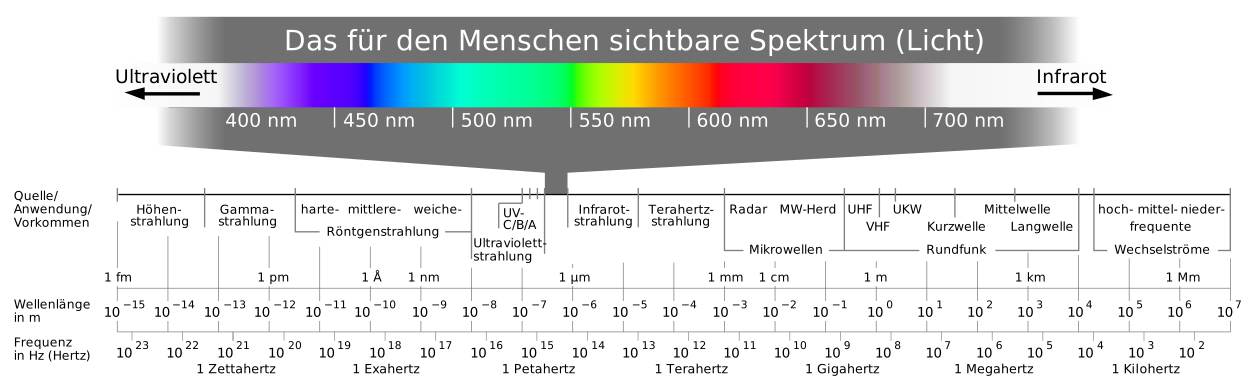
Image source: Horst Frank et al., CC BY-SA 3.0, https://commons.wikimedia.org/w/index.php?curid=3726606
Distinction from other frequency therapies
If comprehensive support for the body, even deep inside, is desired, radiothermy is the right choice. With a wavelength of usually only a few meters, this therapy easily penetrates deep tissue layers such as muscles, tendons, cartilage, and even bones. It generates soothing deep heat that can effectively support the body in its natural biological processes. This unique ability of radiothermy to reach and warm deep-seated structures clearly sets it apart from other high-frequency therapies and makes it a valuable method in therapeutic practice.
Second law of thermodynamics
With higher-frequency radiation such as daylight and infrared, heat penetrates the tissue from the outside to the inside. In this case, according to the second law of thermodynamics, it is impossible for the inside of the tissue to become warmer than the outside. The following always applies: Tinside ≤ Toutside
“Heat cannot spontaneously transfer from a body (tissue) at a lower temperature to a body (tissue) at a higher temperature.” Second Law of Thermodynamics
Radiothermy is not radiotherapy
Radiothermy differs fundamentally from radiotherapy, also known as radiation therapy. While radiotherapy uses frequencies above ultraviolet radiation, radiothermy uses radio waves with significantly lower frequencies. The aim of radiotherapy is to kill diseased cells, whereas we suspect that the frequencies used in radiothermy strengthen the cells. Radiotherapy
Areas of application
High-frequency thermotherapy is used in various medical fields:
- Orthopedics: To relieve joint pain, arthritis, and muscle tension.
- Sports medicine: To treat sports injuries such as strains and bruises.
- Rheumatology: To support therapy for rheumatic diseases.
- Physical therapy: To promote recovery after surgery or injury.
- Cancer therapy: To relieve pain, support wound healing after surgery or radiation, and promote overall longer life expectancy. Deep Dutch Hyperthermia Trial
Conclusion
High-frequency thermotherapy is an advanced technique for pain relief and accelerated healing. It has a wide range of applications, from orthopedics to sports medicine. If you are looking for an effective method to relieve pain and support various processes, high-frequency thermotherapy could be the right option for you.
Interesting facts about diathermy:
Diathermy (from the ancient Greek for heat penetration) or high-frequency thermotherapy, formerly also known as thermopenetration, is a groundbreaking method that uses high-frequency radio waves, low-frequency microwaves, or high-frequency electric current to heat body tissue. Diathermie
Its unique physical principle also enables deep heat development, which differs significantly from conventional heat treatments.
German physician Karl Franz Nagelschmidt conducted the first extensive experiments on patients and is considered the founder of this field. His “Textbook of Diathermy” published in 1913, revolutionized the field and made diathermy popular for the treatment of arthritis and other inflammatory diseases, as well as for pain relief. Diathermy
Nagelschmidt described the heating effect within high-frequency therapy as the “quintessence” and was able to illustrate this with many examples in his book. Unlike the devices developed by d’Arsonval, who introduced high-frequency currents into therapy in 1887, diathermy devices use higher currents at lower voltages. Nagelschmidt – Textbook of Diathermy (p. 315f.)
Quote from „The Secret of Life, Cosmic Rays and Vital Radiations“ by Georges Lakhovsky (1931)
“The relatively long waves currently used in diathermy have a frequency that is far too weak to produce a sufficiently high temperature and enable sufficient localization of the thermal effect. However, with significantly shorter wavelengths, in the range of 1.50 to 3 m, it should be possible to achieve much more intense thermal effects. [….]
In fact, such a device would make it possible to regulate the fever indicated for a disease by generating just the amount of heat needed to melt the nucleus of the microbe causing it. By regulating the energy supplied to the device, it would be possible to control the intensity of the fever from minute to minute without damaging our own cells. Similarly, by opening and closing the device, it would be possible to precisely control the duration of the fever.“ Georges Lakhovsky – Das Geheimnis des Lebens (S.112f.)
Radiothermy – a specialization within diathermy
Radiothermy uses only high-frequency radio waves, usually with a wavelength of a few meters, and no direct electrical currents, thus forming a further specialization within diathermy. Today’s devices have also been further developed and feature improved technology.
Deep hyperthermia: a revolution in medicine and wellness
Hyperthermia, a term derived from ancient Greek meaning “overheating,” has a special significance in medicine. “Heat is a valuable therapeutic agent and has been used for centuries to treat diseases.” Diathermy
Deep hyperthermia, in particular, which involves the targeted heating of deep body tissue, is a special method of heat application. Heat promotes blood circulation and the body’s own healing processes. Since hyperthermia mainly heats the tissue locally through radiothermy, this form of hyperthermia can also be used for longer than other hyperthermia methods.
Advantages of deep hyperthermia
- Targeted treatment: Protects surrounding tissue through targeted heating.
- Combination therapy: Deep hyperthermia can enhance the effects of other therapies.
- Fewer side effects: Offers gentler treatment with improved patient comfort.
- Longer application time: Targeted, local heating allows for longer application than other hyperthermia methods.
Deep hyperthermia in conventional medicine
The positive effects of hyperthermia through radiothermy, especially in cancer therapy, have long been known in conventional medicine.
In 2000, a very interesting Dutch study was published that compared radiotherapy alone with radiotherapy plus hyperthermia in 358 patients with advanced tumors of the cervix, bladder, and rectum. This prospective, randomized, multicenter study showed consistently positive results and improved survival rates. In cervical cancer in particular, the three-year survival rates in the group receiving hyperthermia treatment were almost twice as high as in the control group that did not receive hyperthermia. Comparison of Radiotherapy alone with Radiotherapy plus Hyperthermia
“Since the publication of the Dutch study on radiative RHT (regional hyperthermia) of pelvic tumors, hyperthermic radiotherapy has been considered the standard treatment for patients with cervical cancer in the Netherlands.” (Cervical carcinoma) Locoregional hyperthermia
However, conventional medicine usually refers to the killing of cancer cells when discussing hyperthermia through radiotherapy, which, in our understanding, is not necessarily the case. In addition, this form of therapy is generally only used in combination with chemotherapy or radiotherapy, mainly for the treatment of tumors and pain relief. However, it is not an unknown therapy and there are numerous publications on the subject. Below you will find a small international selection:
- Hyperthermia in oncology
- Clinical application of hyperthermia combined with anticancer drugs for the treatment of solid tumors
- Hyperthermia in the treatment of cancer: Perspectives on its promise and its problems
- Clinical Evidence for Thermometric Parameters to Guide Hyperthermia Treatment
and some from Germany:
- Die kapazitive Hyperthermie scheint das Schmerzansprechen bei der palliativen Bestrahlung von schmerzhaften Knochenmetastasen zu verbessern
- Hyperthermie in Kombination mit Radiotherapie in der Tumorbehandlung
- Hyperthermie: Wärme gegen Krebs
The benefits of fever
Since radiothermal treatment is similar to local fever, here are some quotes that explain the positive effects of fever:
“Fever is a sign of an activated immune system and is seen in holistic medicine as a healing response by the body.” Fever as a healing response; naturopathic and homeopathic treatment options for fever
“A fever in infection is common in animals, and it offers a survival benefit. There are several reasons: human pathogens may replicate less well at higher temperatures; many antibiotics work better; and the innate immune system is more effective.” The Effects on the Body of a Fever
“There are few chronic diseases that cannot be cured by an unexpected fever.
All practitioners of that time repeatedly lament that they do not have the power to induce fever.” Quote from Lakhovsky’s Secret of Life (p. 108)“Give me the power to produce fever, and I will cure all disease.” (Hippocrates) History of Fever Therapy
Myths and stories about fever
In ancient Rome, fever was even worshipped in the form of the deity Febris, who “had the power to inflict a certain evil or (as a healing god) to free people from it.” Febris comes from fervebris, which means “heated.” Febris
Febris probably developed from Februus, the Roman god of purification. This connection between Febris and Februus is evident, among other things, in the idea that sweating during fever was also considered a cleansing and healing process at that time. Februus is probably named after the older festival of Februa, a festival of purification and catharsis celebrated on the 15th of February. Februus Our German word for February is also named after this festival. Februar
This Roman purification festival later became known as Lupercalia and was dedicated to the nature god Faunus, nicknamed Lupercus, “the wolf repeller.” Faunus was the god of nature and the forest, the protector of farmers and shepherds, and corresponds to the Greek god Pan. Faunus Our English word “fauna” (also “animal kingdom”) is also derived from his female counterpart, Fauna. Fauna
Juno, with her epithets Februalis, Februata, or Februa, or Iuno Lucina, was also specially worshipped during this festival. Februa She was the queen of the gods and, according to English Wikipedia, the protector and special advisor to the state, as well as the Roman equivalent of the Greek Hera, goddess of love and marriage. Juno
According to German Wikipedia, Juno was the goddess of childbirth, marriage, and care, and is often equated iconographically with the Egyptian goddess Isis. It is believed that she is also associated with Valentine’s Day, Juno although Wikipedia notes that there is no evidence of a connection with the Lupercalia. Valentinstag
I am not trying to encourage anyone to worship the sun, quite the contrary. However, I find stories interesting, as well as the origins of words and customs. In this context, I would just like to remind you that fever has probably always been seen as a positive side effect.
Future prospects
In a technology-driven world, deep hyperthermia is on the verge of a breakthrough. The Radiothermy Oscillator could play a key role in this by paving the way for a new era in the wellness industry, characterized by efficiency and user-friendliness.
The uniqueness of deep hyperthermia, especially with advanced instruments such as the Radiothermy Oscillator, sets it apart from other heat therapies. The ability to deliver heat precisely and deeply into the body promises not only therapeutic benefits but also an unparalleled heat experience. It may very well be the most luxurious and enjoyable form of heat treatment discovered to date.
